
TIWN Sep 29, 2026
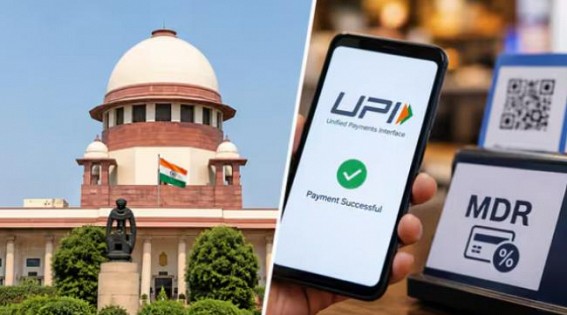
NEW DELHI, Sep 29 (TIWN): The Supreme Court has sought an explanation from the Centre, the Reserve Bank of India (RBI) and the National Payments Corporation of India (NPCI) over the legal basis of the proposed Merchant Discount Rate (MDR) on certain high-value UPI transactions.
A three-judge bench headed by Chief Justice of India Surya Kant, along with Justices Joymalya Bagchi and V. Mohana, was hearing a petition challenging the new UPI MDR framework. During the hearing, the bench questioned the Centre about the nature of the charge and asked whether it was a tax, a fee or another form of levy.
What is the new UPI charge?
Under the framework announced by the government, a 0.4% MDR will apply from October 15, 2026, to specified person-to-merchant (P2M) UPI transactions above Rs.2,000.
However, the change does not mean that every UPI transaction above Rs.2,000 will become chargeable.
-
Person-to-person (P2P) UPI transfers will remain free, irrespective of the amount.
-
UPI payments to merchants up to Rs. 2,000 will remain outside the MDR.
-
The government says around 96% of P2M UPI transactions will remain unaffected.
-
For specified essential and thin-margin sectors, the MDR is capped at ?5 per transaction.
-
For other eligible transactions, the MDR is capped at Rs.300 for payments of Rs.75,000 and above.
Why is the Supreme Court questioning it?
The Centre told the court that the MDR is neither a tax nor a government fee and that the government itself will not receive the money.
According to the government's explanation, the charge is a settlement/service charge within the payment ecosystem, with the money distributed among participating banks and payment-service providers. The government has also said that NPCI does not collect the MDR as government revenue.
The Supreme Court, however, wants the Centre, RBI and NPCI to provide a detailed explanation of the legal and factual basis for the arrangement. The bench specifically questioned what gives the executive authority to impose such a charge and asked for clarity about the service for which the amount is collected.
Court refuses to halt the October 15 rollout
The petition sought an interim stay on the new MDR framework. The Supreme Court did not stay its implementation at this stage and directed the Centre, RBI and NPCI to file their responses. The matter is therefore still under judicial examination, with the October 15 implementation date currently remaining in place.
The case could become important for the future of India's digital-payment system, as the court examines not only the amount of the proposed MDR but also the legal character and authority behind the charge.
- ‘Another Example of the State’s Law-and-Order Failure’: Jiten Chowdhury on Shooting of Tipra Motha Candidate
- ‘Is UPI Charge a Fee or Tax?’: Supreme Court Seeks Clarity From Centre
- Polling Personnel Leave for Designated Centres Ahead of Tripura Village Committee Polls
- Knife-Point Robbery Reported in Matinagar; Gold Chain, Cash and Mobile Phone Allegedly Snatched
- Tripura Government Raises Festival Advance and Grant Ahead of Durga Puja
Special Articles
 Sanjay Majumder
 Anirban Mitra